


Preview: Johns Hopkins University’s Bloomberg Center’s Integrated Timber Roofscape
The new Bloomberg Student Center at Johns Hopkins University showcases a groundbreaking approach to mass‑timber roof design. It features 29 unique timber roofs, all engineered to appear as continuous, seamless architectural surfaces. Above and below the deck, every detail had to be orchestrated with extraordinary precision to preserve the clarity of the design.
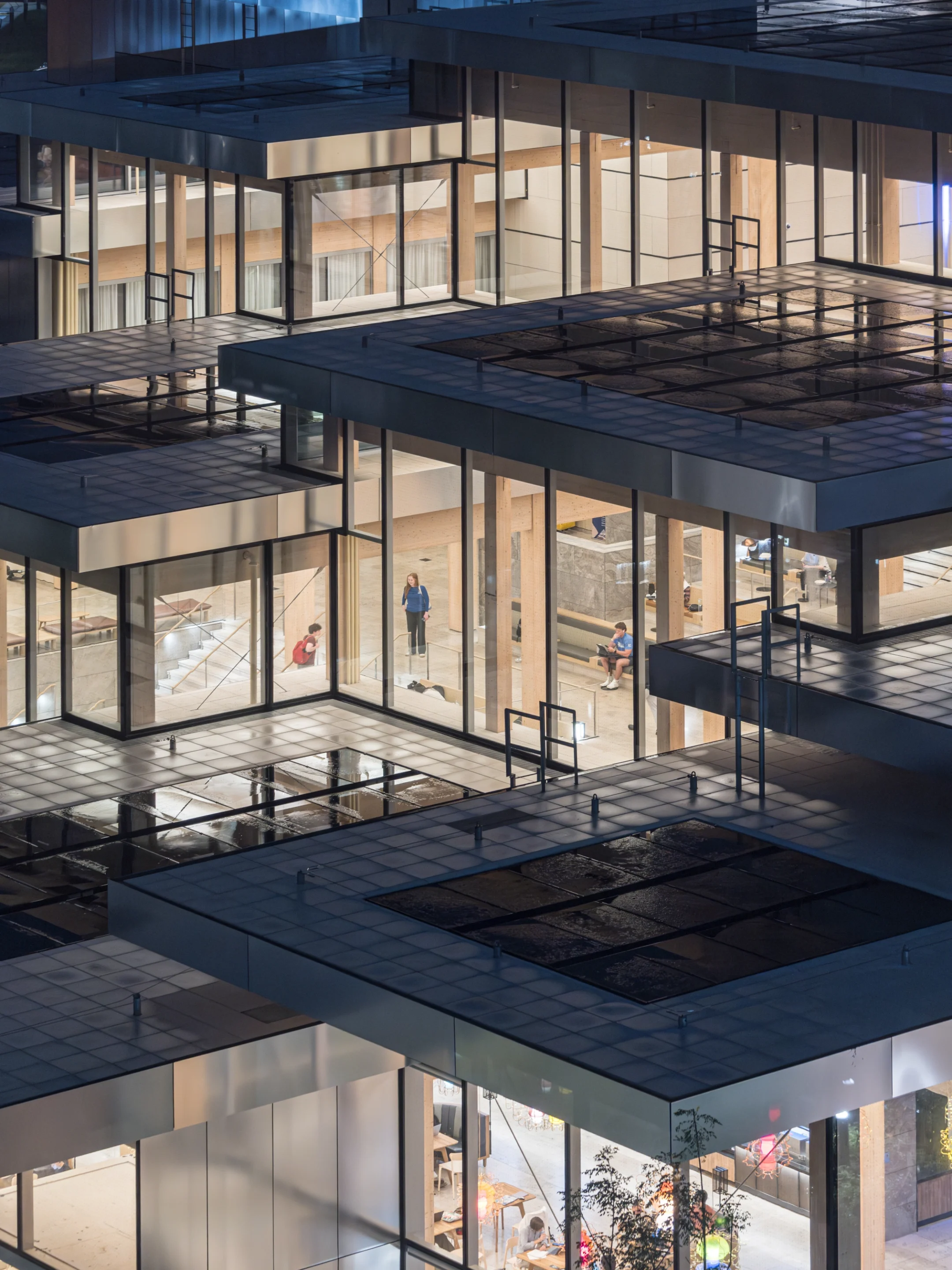
Bloomberg Student Center, Johns Hopkins University, Baltimore, MD. Photo by Laurian Ghinitoiu.
This preview of our white paper highlights the project’s signature innovations and design breakthroughs. Curious to learn more? Read the report.

Bloomberg Student Center, Johns Hopkins University, Baltimore, MD. Photo by Laurian Ghinitoiu.
Why the Roofs Matter
At first glance, the building’s roofs look simple: clean planes, uninterrupted lines, warm timber soffits. But behind that refined appearance lies a tightly choreographed technical system:
- 29 distinct roofs, each with different slopes, drainage patterns, and structural requirements, yet all aligned to a fixed fascia datum that controls what the public sees.
- Roof planes that continue from exterior to interior, creating the feeling that the building’s envelope folds inward in one continuous motion.
Achieving that illusion required deep coordination across architecture, structure, envelope, acoustics, and MEP systems.
Timber Innovation from Root to Roof
The design team selected Dowel‑Laminated Timber (DLT) for its refined appearance and acoustic benefits. Factory‑milled flutes filled with acoustic material create a quiet, warm interior experience—but also demanded highly precise coordination of:
- Rated assemblies
- Beam intersections
- Exterior transitions
- Connection to the curtain wall and metal panels
DLT’s one‑directional strength also led to the use of oversteel: hidden steel supports inserted where cantilevers exceeded timber’s weak axis capacity. The introduction of oversteel required the team to repeatedly recalculate slopes and drainage on nearly every roof.
Hiding the Complexity
Interiors: The Trench System
Since the building celebrates exposed timber, leaving visible wiring, conduit, and devices was not an option. The solution was the creation of a custom trench system; longitudinal cavities were placed every 7 feet between DLT panels. The trenches were covered with wood panels which were fabricated to appear as DLT panels and therefore were visually hidden. These trenches allow the team to:
- Conceal electrical and low‑voltage wiring
- Maintain high/low voltage separation
- Mount devices in visually consistent locations
- Keep ceilings nearly free of visible systems
In fact, sprinkler piping is the only major system intentionally left exposed.

Bloomberg Student Center, Johns Hopkins University, Baltimore, MD. Photo by Laurian Ghinitoiu.
Exteriors: Buried Treasure
Nothing could rise above the fascia—including rooftop HVAC. The team recessed all mechanical equipment into a series of five custom wells, each accessible from above or via interior stairs. Deep overhangs (up to 12 ft) required concealed sprinkler protection, and solar panels had to be installed in ways that aligned precisely with pavers and fascia constraints.
Innovation in Action:
A New Kind of Air‑Barrier Detail
DLT timber panels have natural gaps between boards, which cause an issue when connecting to an airtight building envelope. The design team worked with envelope consultants and the timber fabricator/designer to invent a never‑before‑used detail:
- Factory‑drilled holes through each DLT board at envelope interfaces
- Field‑installed silicone air‑barrier sealant (GE Elemax) injected between the boards
- Additional top beads of silicone beneath a plywood diaphragm completing the airtight seal
- The curtain wall and metal panel wall below the DLT deck tie the air/water to the GE Elemax above.
This new system resolved air infiltration challenges while preserving the exposed timber aesthetic.
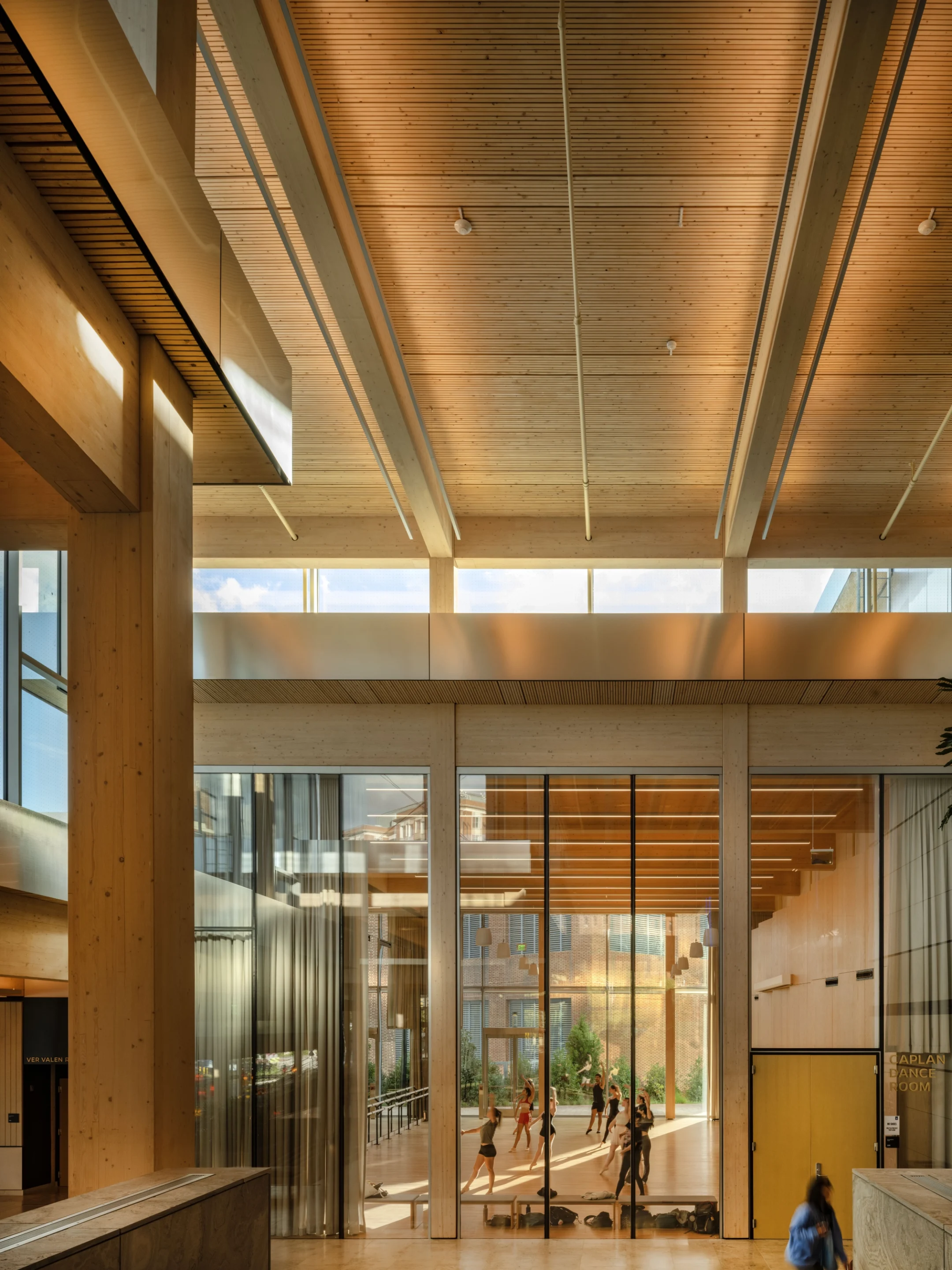
Bloomberg Student Center, Johns Hopkins University, Baltimore, MD. Photoby Nic Lehoux.
This project sets a new standard for how mass‑timber roofs can be integrated into expressive architecture without compromising performance. Ready to learn more? The full white paper includes:
- Details on trench, fascia, and envelope connections
- Full explanation of the air‑barrier system
- Lessons learned for future mass‑timber and hybrid envelope projects
- And much more!

Matthew Gifford, AIA, LEED AP
Principal
Matt’s collaborative approach to the design process has created highly sustainable, highly functional academic, library, and student life facilities. He is committed to developing solutions that are unique to each client’s culture and goals.

Michael Harrison
Senior Designer, Associate
With over 30 years of experience, Michael has been instrumental in the resolution of design and detailing on complex exterior envelopes of large buildings.