


Designing a Custom Creative Thinking Game: From Concept to Community
By Natalie Shutt-Banks and Sabin Ciocan
How do you spark creativity and empathy in a fast-changing world? For our annual All-Firm Design Charrette, the answer emerged through a collaborative journey—one that blended rigorous systems thinking and infused the element of surprise all the while folding in the unique culture and values of our firm.
The result: a custom, creative thinking game, designed to help teams break through creative blocks, foster community, and reimagine the role of architecture. Early on, we realized we were building more than just a game, we were trying to build a way for our firm to develop a shared language of care.
Follow on Instagram for your chance to win your own set of cards.
The System: Karl Gerstner and the Design Programme
As often happens, the inspiration came from outside the architecture realm. This time, it was graphic design legend, Karl Gerstner’s Designing Programmes that became the intellectual backbone.
His central idea:
Define the variables and rules, and the system will generate more possibilities than any individual designer could.
In that spirit, we distilled architectural care into four core variables, the columns of our grammar:
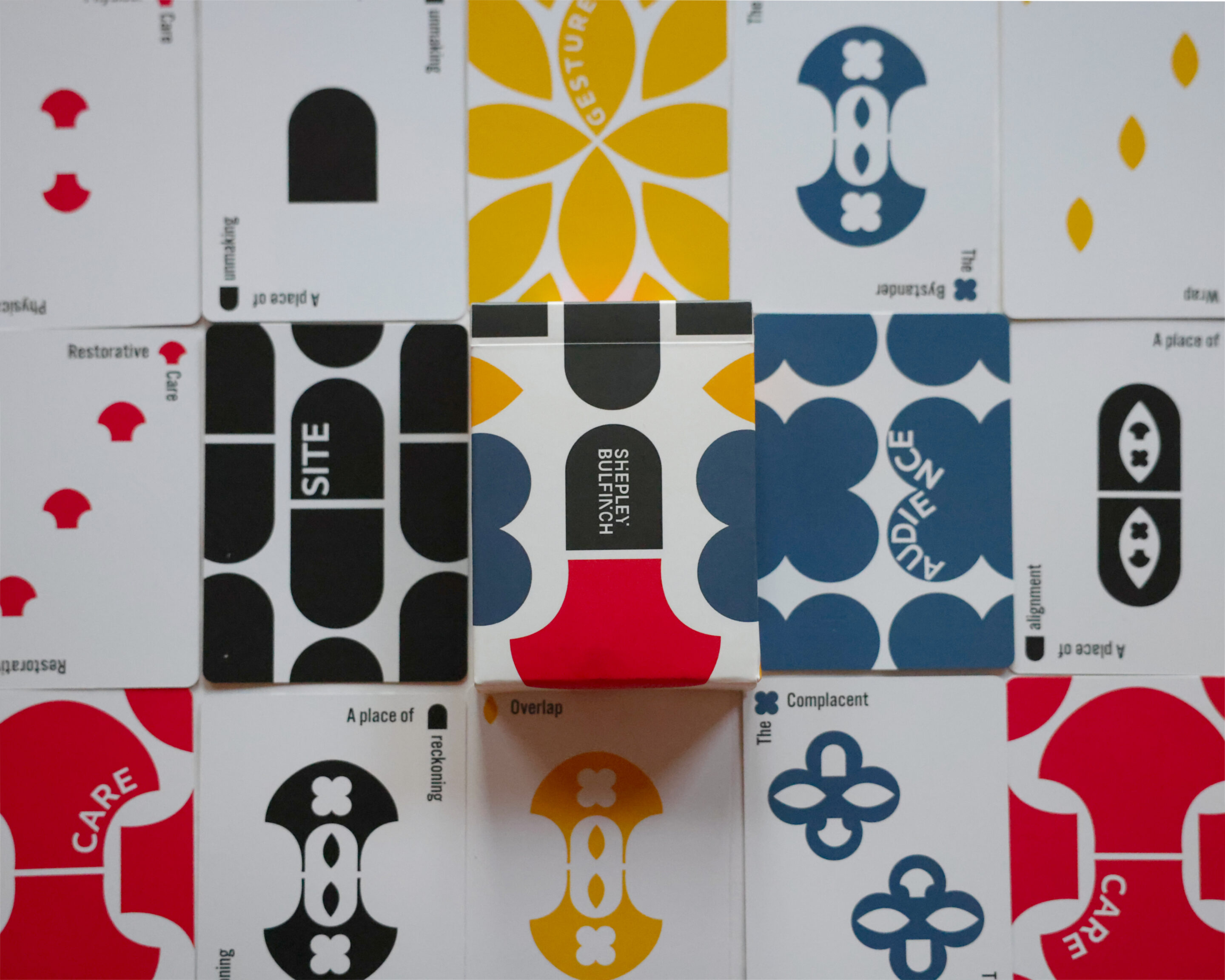
- Gesture – the architectural move (these gestures would be familiar to readers of Operative Design by Anthony Di Mari & Nora Yoo)
- Audience – the people being held/cared for
- Care – the type of care provided
- Site – the place, threshold, condition
Each card is a word.
Each suit is a category.
Each hand forms an architectural sentence.
And from those sentences, players craft surprising stories.
The Suprise: Oblique Strategies and Beyond
Oblique Strategies, created by musician Brian Eno and artist Peter Schmidt, is a legendary deck of cards filled with prompts like “Abandon normal instruments” or “Honor thy error as a hidden intention.” These cards are designed to jolt creative minds out of ruts and encourage lateral thinking.
The four card types when dealt as a hand push and pull the concepts in unexpected and nonlinear ways that force them to be tied together through joint experience and storytelling. The meaning-making is both given by the hand and through the interaction of the players.
Our team saw an opportunity to adapt this Eno and Schmidt’s approach for collaborative storytelling and problem-solving in the context of design charrettes and team workshops. This ethos of improvisation and “permission to break the frame” served as a counterweight to Gerstner’s structure. This influence kept the system alive, elastic, and surprising.
The Why, The Purpose?
The process began with care and community as the guiding north star. The game needed to support and build community, both within our studios and in the wider world. Early brainstorming sessions focused on how to make the game move beyond architecture as the only solution. The goal was to create a tool that has a shared starting point for every participant; one that could generate empathy and build camaraderie, all while remaining inclusive of different disciplines and departments across the firm.
The Houston tie in
Since we gathered for the charette in Houston, we also knew that we wanted to approach this year’s charette with a little more playfulness; something like a game. That’s when the metaphor snapped into place:
Texas, Hold ’Em
“Texas” (where the charette would be)
“hold ‘em” (to be held, or cared for).
In poker, the cards you hold in common create the conditions of play.
In this game, care is the shared cards on the table, the thing everyone must respond to, interpret, and design from.
From Brainstorming to Prototyping
Prototyping was a hands-on, collaborative effort. The team designed and tested the cards both in person and virtually, constantly refining the prompts and mechanics. The challenge was to keep instructions simple—participants had only minutes to grasp the game, so clarity was key.
Storytelling and Community Impact
The game’s true power was revealed as teams used the cards to create stories and solutions for community wellness. The prompts encouraged participants to look beyond architectural answers, considering broader interventions and care strategies. Teams were given tactile tools such as watercolors, pens, paper to help the teams develop their ideas The solutions ranged from field guides and hospital-dog shelters hybrids to spaghetti bowls and tapas—each one deeply tied to the four card categories and the firm’s core values.
Visual Design: Tradition Meets Innovation
Inspired by traditional playing cards, the team crafted visually engaging cards that felt familiar yet fresh.
For the look of the deck, we went back to the Texas Hold ‘em inspiration and traditional card suits. We reimagined the suits as conceptual, architectural symbols. It should functions as a visual grammar: a set of elemental forms that was:
- Geometric (not too literal)
- Symbolic (not just illustrative)
- open enough for interpretation, precise enough for categorization
- simple in form, rich in internal logic
Lessons Learned and Next Steps
The process of designing this custom card game highlighted several key lessons:
When we made this game, it was never about providing our team an outlet to come up with innovative architecture. What we really set out to do was to provide a platform for them to re-imagine, to improvise and ultimately tell a compelling story of care—one that could take the shape of a building…or not.

Natalie Shutt-Banks, AIA, NOMA
Architect, Associate
Natalie is an experienced architect who thrives when navigating between the vastness of all creative possibilities and the real-world constraints of any design problem.

Sabin Ciocan
Designer