


Phased Renovations: 10 Strategies for Transforming Libraries Without Pressing Pause
by Kelly Kapinsky, AIA, LEED AP, and Kalyn Pavlinic, NCIDQ, LEED AP, IIDA
You need a new library, but you can’t close your doors. Good news: large-scale library renovations rarely happen all at once anymore. With limited funding, evolving user needs, and the challenge of maintaining operations, many institutions are turning to phased renovation strategies to transform their facilities.

Francis A. Countway Library of Medicine, Harvard Medical School, Boston, MA. Photo by Marjorie Becker, CAP/Accidentally Wes Anderson.
The most successful phased renovations are not simply divided into smaller construction packages. They are carefully planned, strategically sequenced, and designed to create momentum while supporting day-to-day operations. Based on our experience helping libraries navigate complex renovation projects, here are ten principles that consistently guide successful phased renovations.
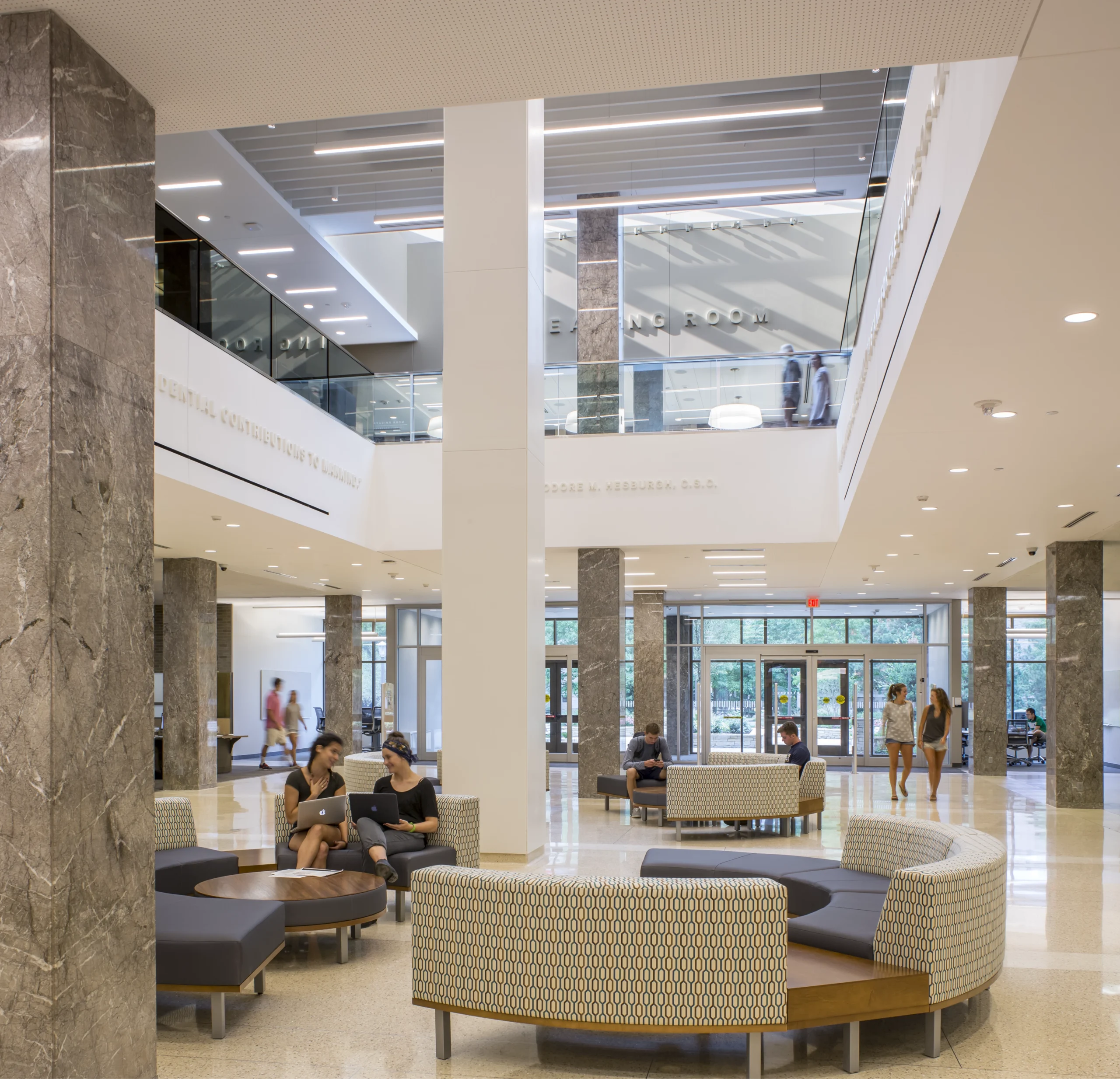
One of the top priorities for the renovation of University of Notre Dame’s Hesburgh Library was the integration of natural light into the large floor plate. Photo by Jonathan Hillyer.
1. Identify Priorities and Tradeoffs Early
Every phased renovation begins with difficult decisions. Is the primary goal improving user experience? Addressing aging infrastructure? Supporting new service models?
Establishing priorities early helps stakeholders evaluate tradeoffs and make confident decisions when funding, schedule, or operational realities require adjustments.
2. Test Multiple Phasing Scenarios
The most obvious phasing plan isn’t always the best one.
Exploring different scenarios can reveal unexpected cost savings, operational efficiencies, or opportunities in future work. Sometimes completing a larger phase earlier can be more economical than spreading work across multiple smaller projects.
3. Plan Around Programs, Operations, and Building Systems
Phasing is about more than construction sequencing. Mechanical systems, life safety requirements, service delivery models, and operational priorities all influence what can happen when.
Understanding these relationships early helps prevent costly redesigns and unexpected roadblocks later. Bringing engineering consultants into the master planning and feasibility studies helps to identify the best way forward and answers crucial questions:
How should phasing proceed?
Do mechanical systems feed by zone or by floor?
Should renovations go from the top down or bottom up?
4. Consider a “Feature-First” Approach
Try starting with a showstopper. One of the most powerful phasing strategies is delivering a highly visible, high-impact space early in the process.
Whether it’s an entrance, learning commons, or gathering space, an early transformation can help stakeholders, donors, and users see the potential of the broader vision and build support for future phases.
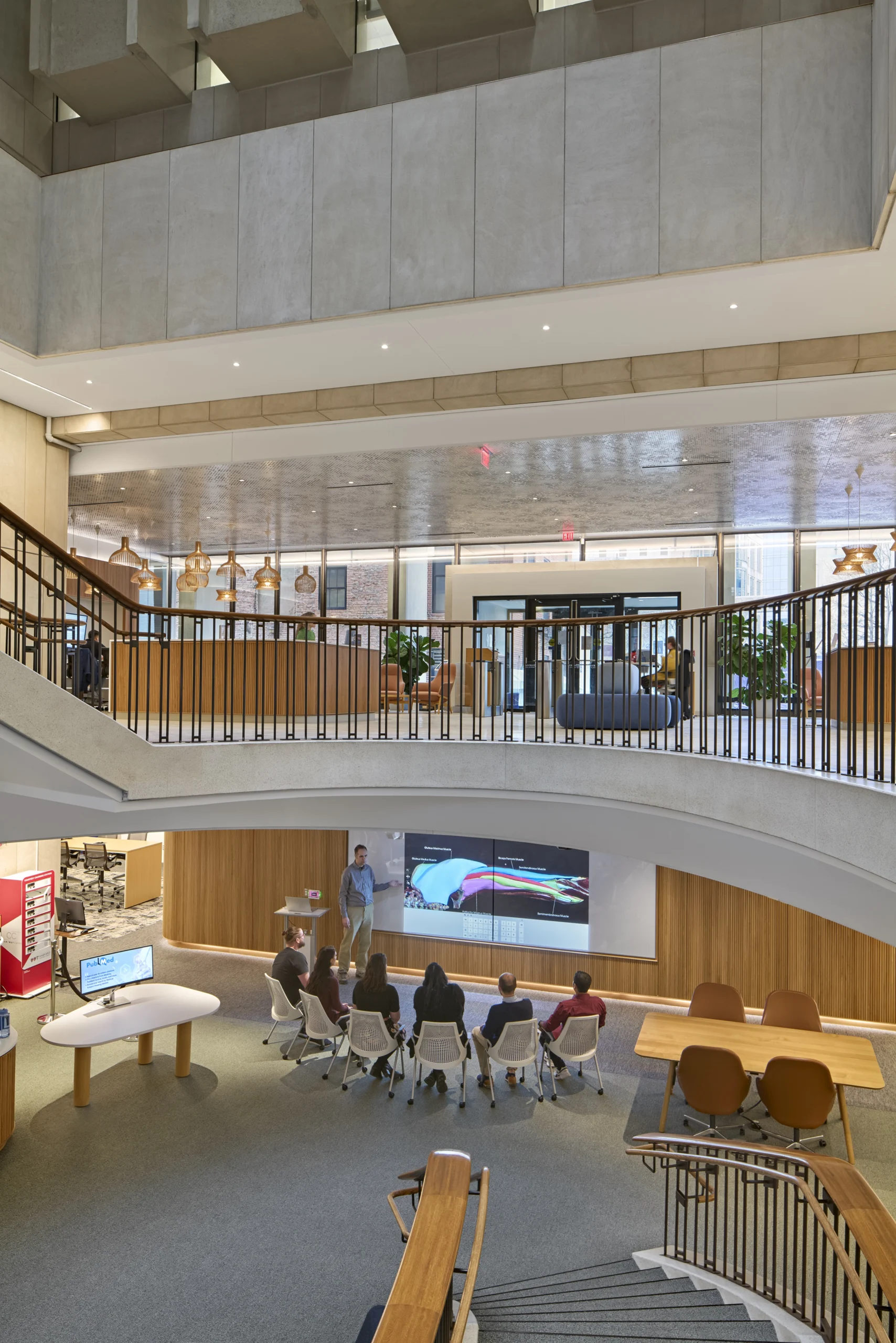
At Harvard Medical School’s Francis A. Countway Library of Medicine, renovations to the entry level delivered an early showstopper, creating momentum for further renovations on the lower level. Photo by Robert Benson.
5. Prototype Before You Build
Renovation projects increasingly involve new service models, workplace strategies, and operational approaches.
Testing ideas before construction begins can provide valuable insight into what works, what doesn’t, and what adjustments should be made before significant investments are made. Sometimes the most valuable outcome of a prototype is discovering a better solution.
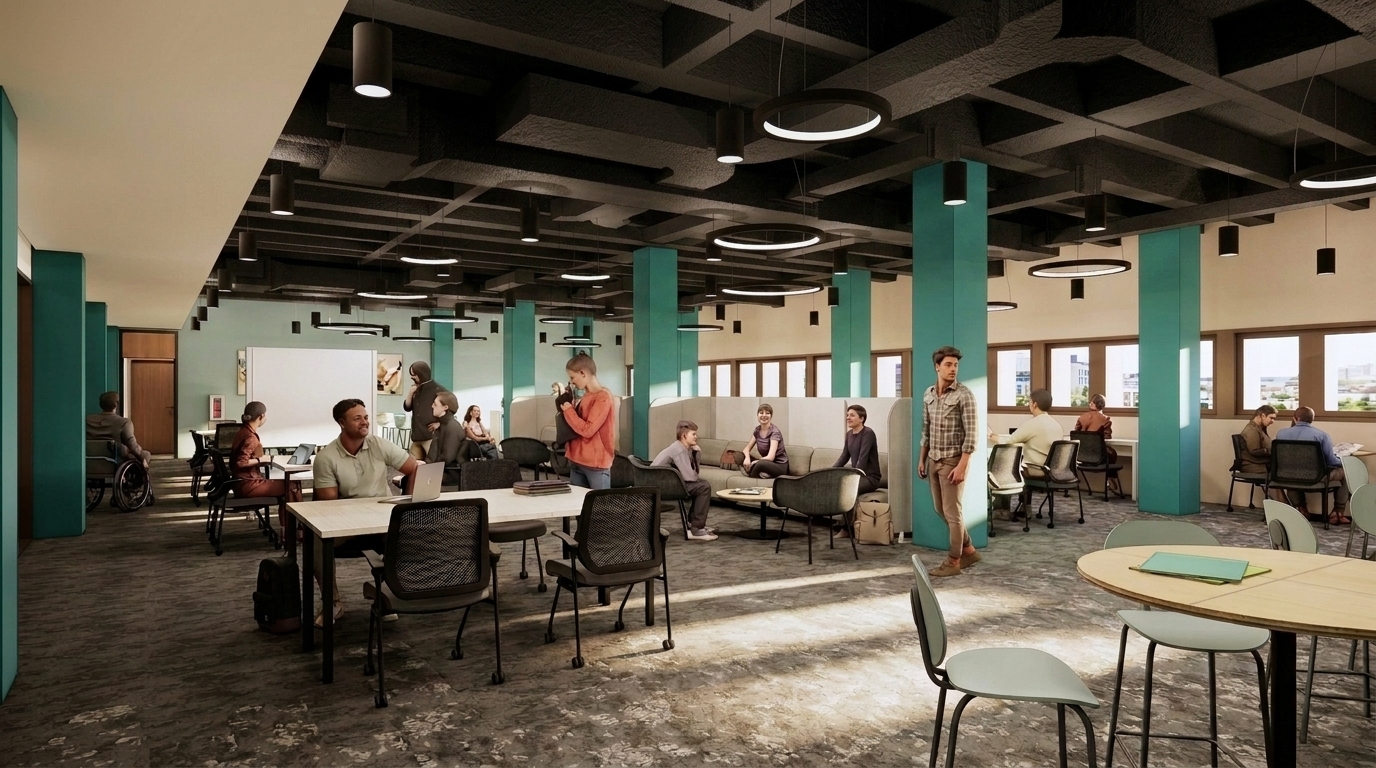
The renovation and expansion of University of North Carolina Greensboro’s library is being completed in two phases while the building remains occupied. The newly renovated learning lab will be used by staff during the construction of Phase Two of the project.
6. Look for Enabling Opportunities
Successful phasing often depends on identifying spaces that can unlock future work. A newly renovated area may serve as temporary swing space, allowing other portions of the building to be renovated with less disruption.
Thinking strategically about these opportunities at the beginning of a project can streamline the renovation process.
7. Minimize Moves Through Smart Swing Space Planning
A phased approach should minimize the need for occupants to relocate more than once during the renovation.
Identifying temporary spaces in advance helps reduce disruption for staff and faculty while maintaining continuity of service. This helps prevent low morale and keep operations functioning efficiently.
8. Build on Lessons Learned
Recent years have demonstrated how quickly institutions can adapt. Hybrid work models, virtual engagement strategies, and new service delivery approaches have created opportunities for more flexible renovation planning. Many institutions test new ideas based on when the funding is available, whether that’s experimenting with service models, buying different furniture, or bringing a new program into a temp space.
By capturing these lessons learned, our team can take a more informed approach to planning and design, while institutions can rethink how space is used during and after construction.
9. Commit to Consistent Communication
Phased projects often span multiple years and involve a wide range of stakeholders. Library leadership, staff, campus partners, donors, and users all need visibility into the process.
Clear communication helps maintain alignment from planning through project completion and minimizes surprises along the way.
10. Stay Flexible and Think Creatively
If there’s one certainty in a multi-year renovation effort, it’s that conditions will change. Funding evolves. Organizational structures shift. Priorities emerge.
Effective phased renovation strategies embrace that reality. The goal is not to create a rigid roadmap but a resilient framework that can adapt while continuing to move toward a long-term vision.
Looking Ahead
Every phased renovation is different. Some institutions divide projects based on available funding. Others phase work to keep buildings operational throughout construction. Many combine both approaches.
In upcoming articles, we’ll explore how these strategies have shaped real-world library projects and examine different models for phased transformation, including strategies to maintain operations through construction and minimize disruption, as well as those designed to generate donor interest and build momentum to complete future phases.

Kelly Karpinsky, AIA, LEED AP
Principal
An accomplished library designer, programmer, and planner, Kelly has worked on a wide range of collegiate libraries and learning commons throughout the United States and internationally.

Kalyn Pavlinic, NCIDQ, LEED AP, IIDA
Principal
Kalyn weaves together an understanding of user needs and institutional goals with a strong design aesthetic rooted in human behavior and spatial experience.